
Built to Be Open, Behind a Waitlist: Building for MemoMind Anyway
I bought MemoMind glasses to build on them, found the developer platform was invitation only, and shipped two self-hosted apps in four days anyway.

Sekou M. Doumbouya
Listen to this article
The views expressed here are my own and do not represent those of any current or former employer.
Two days after my MemoMind One glasses arrived, I opened the MemoMind app on my iPhone, went to Settings, then Memo Lab, and looked for the Developer Workspace. The quickstart guide said it would be there. It wasn’t.
That missing menu item is how I learned that the developer platform I bought the glasses for is invitation only. I’m still on the waitlist as I write this. In the four days between the box arriving and today, I also built and shipped two self-hosted apps for the glasses: Anvil Scribe, a dictation tool that rewrites what I say, and Anvil Agent, which puts my own AI agents on the heads-up display. Both are merged and running on my home server. Neither has touched a real pair of glasses yet.
The Pitch Said Open
The product page doesn’t hedge. It says the glasses are “Built to be open, so developers can easily extend, integrate, and create on top of the platform,” and it links to a developer platform, documentation, and a Discord. Nothing on that page mentions a whitelist or a waitlist.
That pitch is a big part of why I bought them. As I put it to Claude on November 25, a few minutes after finding the empty menu: “I was under the impression that I would be able to develop on this platform… That was like one of the main advertisements that I saw.”
The gate does exist in writing. It just lives somewhere else. A September 30 press release announced that the App Workspace, the piece that actually loads your app onto the glasses through the phone, would enter a closed beta in October, with access by whitelist invitation. A packaged SDK and a marketplace are later phases. The open-source SDK is real and on GitHub. The ability to run what you build on hardware you own is not, unless they invite you.
So that’s my read: an open platform with a closed front door.
I emailed support on the 25th, filled out the closed beta form the same day, and sent a follow-up describing exactly what I wanted to build. Support answered the next day: access is currently by invitation, apply through the form, and they’ll get back to me after review.
Blue is the platform and access side of the story. Orange is what I built.
- Nov 13 Order confirmed. The product page promises a platform "built to be open."
- Nov 23 Glasses arrive. The first plan finds no cloud API, no webhook, no MCP: the only way in is a plugin inside the phone app.
- Nov 24 A tailnet-only test server answers iPhone Safari. The same request from inside the MemoMind app never arrives.
- Nov 25 No Developer Workspace on the phone. Support email, then the closed beta form.
- Nov 25 First real memo through the relay in Plugin Studio: transcribed in 225 ms.
- Nov 26 Anvil Scribe merged into Anvil Serving as a product family.
- Nov 26 Anvil Agent goes live. The relay is retired 21 minutes later.
- Nov 26 Support replies: access is by invitation, and the application is under review.
There Is No API, Only a Plugin
Before the access question came up, I had already learned the shape of the thing. On November 23, the first planning session found that MemoMind has no cloud API, no webhook, and no MCP server. The only way in is a web plugin that runs inside the MemoMind phone app, which talks to the glasses over Bluetooth. And because iOS suspends that plugin when the screen locks, anything I built would be push-to-talk with the app open.
I was fine with that. What I wasn’t fine with was where the audio goes. My understanding is that the built-in assistant runs on Google’s models, and I said so plainly: “I don’t want to send any of my stuff to Google if we can avoid it.” So the plan became my own speech-to-text and my own models, reached over my private Tailscale network, with nothing exposed to the public internet.
Left to right on a wide screen, top to bottom on a phone. Blue is MemoMind's and gated. Orange is mine.
I did look under the hood first. A Bluetooth scan in pairing mode found two vendor services and no firmware update service, and the SDK’s own capability notes say firmware updates and raw flash access are deliberately not exposed. I could have kept probing. Instead I asked a simpler question: “how about we just focus on developing things through the SDK and their platform instead?” No decompiling, no protocol capture, no reflashing. The Open Platform Terms ended up shaping the design in useful ways. Sending my own glasses audio to my own speech service is allowed. Using that audio to train or evaluate models is not, so the memo store carries an exclusion marker that my voice tooling refuses to cross. And no API keys may live in plugin code, which pushed every credential to the server side.
The Relay Was the Baby Step
The first thing I shipped was barely a thing. An echo server on my home server, published only on my tailnet, with an access rule that let exactly one device in: my phone. Safari on the iPhone reached it on the first try, Tailscale identity attached.
From inside the MemoMind app, the same request never arrived. I still don’t know why. It could be a network permission, the plugin’s content security policy, or the app not routing over the tailnet at all. Without developer access I can’t load a plugin onto the phone to find out.
So the simulator became the phone. MemoMind ships a desktop Plugin Studio for Windows, and a probe plugin running there reached my server over every path I tried. That was enough to build the real relay: take the Ogg Opus audio the plugin records, convert it to WAV, and send it to a Parakeet speech-to-text model on a MacBook. On November 25, the first real memo went through. A fifteen point nine second recording came back transcribed in two hundred twenty-five milliseconds.
The relay taught me most of what I now know about this SDK. The capture API streams Opus, while my existing realtime voice service only accepts raw PCM audio, so the conversion had to happen on the server. The simple recording call caps out at fifteen seconds. And Plugin Studio keeps the previously selected build loaded after you change the code, which is how my first “version 0.2.0” test was actually version 0.1.0. Nothing humbles you faster than benchmarking the wrong build.
I also started the relay the lazy way, as a background shell, and it died with the session. Everything on my home server runs as a Docker Compose service, so the relay became a hardened container.
Anvil Scribe Is the Thing I Actually Wanted
Once memos worked, the scope changed. I didn’t want one cleanup pass. I wanted selectable modes, the way SuperWhisper does it: say something once, then turn it into an email, a task list, meeting minutes, or a cleaner version of what I meant.
Anvil Scribe is record first. The raw transcript is always saved, and a rewrite is optional. There are eight built-in rewrite profiles plus custom ones, a model picker, and a history view. On the glasses, a press starts and stops recording, and a double press cancels without uploading.
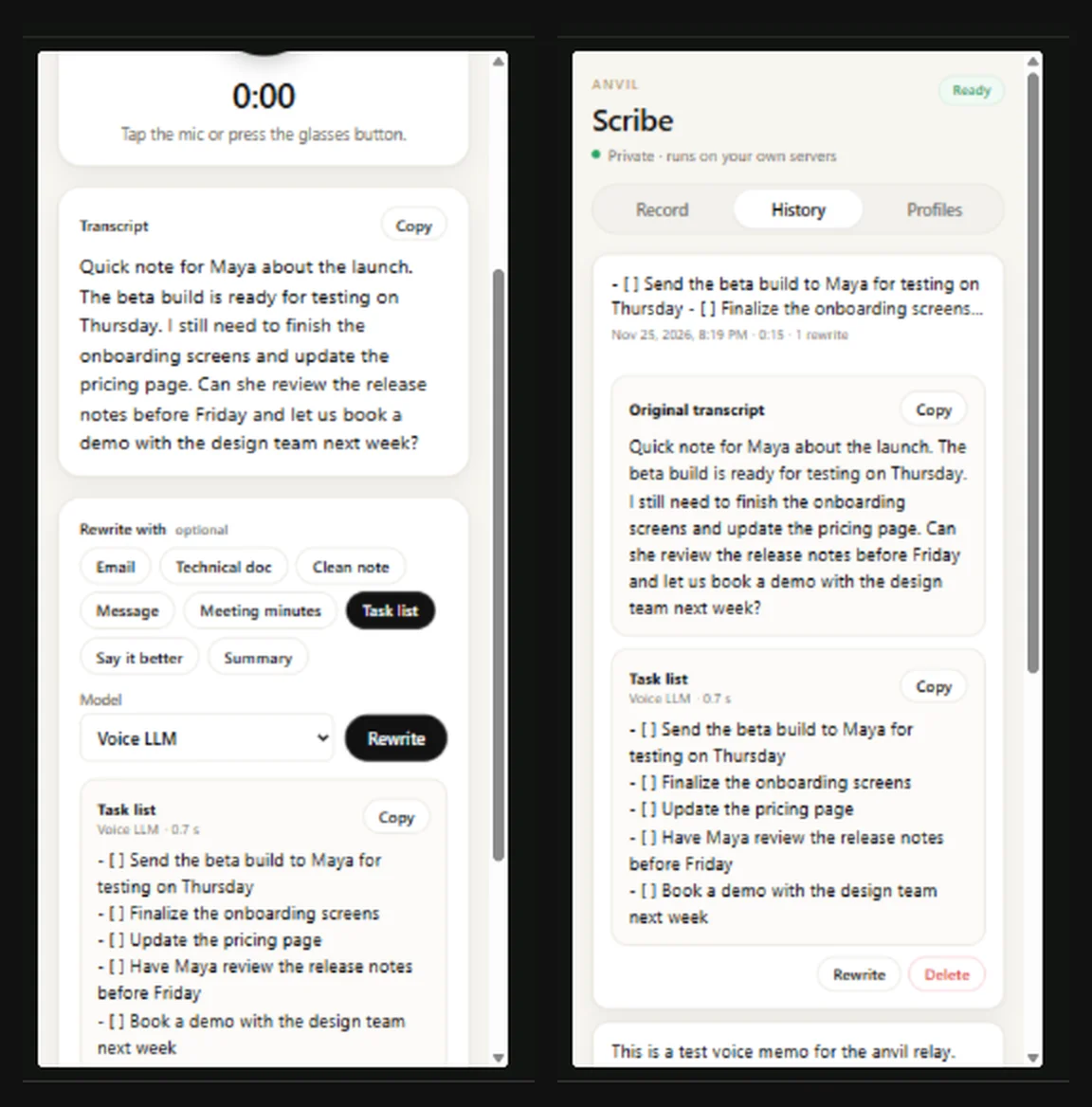
Captured in Plugin Studio against my live server. The dictation is a demo script spoken by a local text-to-speech voice, not audio from the glasses. The transcript and rewrite are real outputs.
It also stopped being a side project. Scribe became a product family inside Anvil Serving, merged on November 26, with an anvil-serving scribe command and a new kind of credential: a device key that can be granted transcription for one specific route and nothing else. That closed a gap the relay had worked around by calling the speech model directly.
The numbers are why I use it. A memo upload, including transcription, took about three tenths of a second. A task list rewrite on a small four billion parameter model took seven tenths of a second, and an email rewrite took nine tenths.
The speech path stays under about a second. The long bar is an agent deciding what to do.
Data table
| run | seconds |
|---|
That small model also produced my favorite bug. The email profile told it, in plain words, never to invent names. It signed emails “Best, Alex” anyway. Prohibitions didn’t work. A layout template did: subject, greeting, body, “Best,” and then nothing. Three runs out of three came back clean. On models that size, show the shape you want instead of listing what you don’t.
The display had its own lessons. The heads-up display is six hundred by three hundred fifty pixels and grayscale, and my early cards were budgeted at two hundred eighty characters before long results started to clip. So version 0.6.2 added paging: press for the next page, double press to go back, hold to close. A review pass on version 0.6.1 found nine real defects, including one where an error mid-recording threw the audio away. Those are exactly the bugs you want to find before a microphone is on someone’s face.
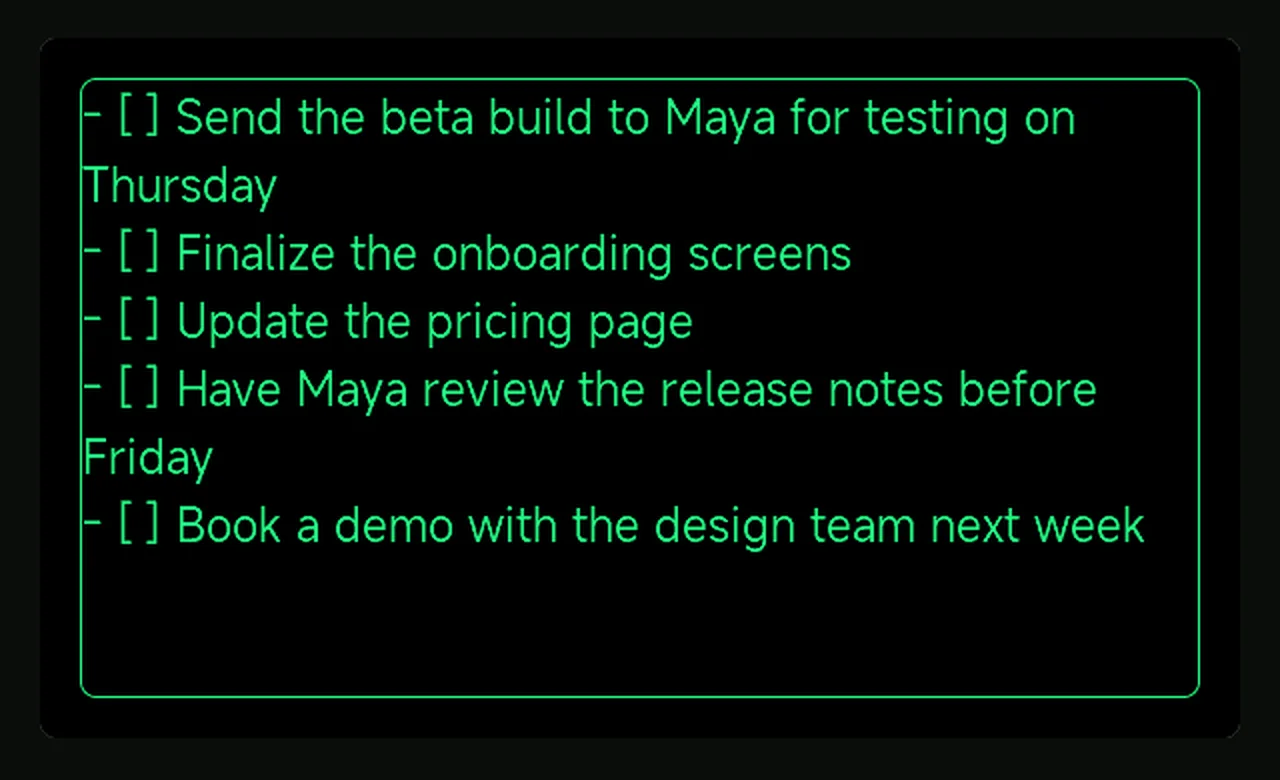
The same task list on the simulated glasses display. Same caveat: a synthetic demo dictation, real rewrite.
Anvil Agent Puts My Own Agents on the Display
The second app came out of a question I couldn’t stop asking: if the glasses can show text and hear me, why can’t they talk to the agents I already run?
MemoMind has an official integration for one agent platform, OpenClaw, but it’s control only and doesn’t help my Hermes agent. So Anvil Agent is one glasses app with pluggable agent backends, Hermes first. Hermes gets a small MCP tool that mirrors the control operations OpenClaw has: show a notification, run a teleprompter, stream live captions, or ask me a question. Anything that would open the microphone only shows a request card until I press the button myself.
It merged and went live on November 26. In Plugin Studio, a typed request that made Hermes call the tool came back in six point eight seconds. A spoken turn, using synthesized speech, came back in one point one six seconds. I read most of that gap as the agent’s own thinking time.
The review rounds on Agent were the most useful of the week. One finding showed that a batch of large uploads could balloon the service’s memory to over two gigabytes, so request bodies are now capped and counted before they’re read. Another showed that guards wrapped around Python’s email parser kept getting bypassed, so both Scribe and Agent now share one flat multipart parser with a strict header limit.
Twenty minutes after Agent went live, I retired the relay. As I put it at the time: “There’s no reason to run the relay at this point. Since we have full-fledged apps.”
What Doesn’t Work Yet
Everything above was tested in Plugin Studio on Windows, against my live server. None of it has run on the actual glasses or the actual phone, because that requires the developer access I don’t have. The iOS web view’s origin, which my server needs in its allowlist, is still a guess.
True real-time streaming isn’t shipped. The router change that would carry the realtime voice WebSocket, with authentication, is an open pull request. Until it lands, live captions are windowed re-transcription: every two seconds, the plugin re-sends the last thirty seconds of audio. It works well enough for captions.
The Pi agent backend is built but not wired up. And iOS stops the plugin from polling when the app is in the background, so agent cards queue until I open it again.
The developer gotchas, with code, are in a separate technical post for anyone building on the SDK.
Build the Room Behind the Door
The slowest part of the week wasn’t code. It was finding out what I was allowed to do: which integration point exists, which menu I’ll never see, which terms apply. The fastest part was everything I owned end to end. Scribe went from “the first memo works” to a merged product family in about eight hours, because the server, the network, and the models were mine.
That’s the pattern I’d hand to anyone buying hardware for its platform. Find the real integration seam before you write code, since the marketing page may not show it. Then own the server side, because that part doesn’t wait on anyone’s invitation.
When the invitation comes, the hard part is already running. If it doesn’t, my home server still has a fast, private dictation and agent service that works with anything that can record audio. The door is still closed. The room behind it is finished.
Co-authored with AI, based on the author's working sessions, dictations, and notes.
Explore the source
fakoli/anvil-serving
This article discusses an open-source project. Star it, fork it, or open an issue.